

What Makes a Front Entrance Instantly Captivating?
The front entrance of a home does something no other part of the property does: it forms the first impression before anyone has stepped inside. In the first seconds of approach, a visitor is absorbing information about the home and its occupants — whether the space feels welcoming or guarded, considered or neglected, personally expressive or architecturally anonymous. That absorption happens faster than conscious evaluation and leaves an impression that shapes everything experienced afterward.
Most US homeowners treat the front entrance as a functional zone — a pathway to the door, a place for a doormat, maybe a potted plant or two. The homes that stop people on the street, that make guests slow down before they’ve even reached the door, are doing something more deliberate. They’re applying specific design principles to the entry sequence — the experience from the street to the threshold — that most homeowners have never been taught to think about.
This article covers exactly what makes a front entrance captivating: the visual hierarchy principles, the material and lighting decisions, the plant and scale choices, and the specific elements that transform a functional entry into something that makes people want to arrive.
Why the Front Entrance Matters More Than Most Homeowners Think
The front entrance communicates before anyone says a word. Environmental psychology research on first impressions of residential properties consistently finds that approach experience — the sequence from street to door — forms evaluations that persist through and beyond the interior experience.
For homeowners preparing to sell, this is documented in real estate data: NAR’s 2023 Remodeling Impact Report identifies entry door replacement and landscaping (both primarily front entrance investments) among the highest-ROI exterior improvements available. For homeowners simply living in their homes, a compelling front entrance produces a different daily arrival experience — one that feels like returning somewhere considered and specific rather than somewhere generic.
| Front Entrance Element | Impact on First Impression | Impact on Property Perception |
|---|---|---|
| Entry door condition and color | Very High — primary focal point | Direct correlation to perceived maintenance quality |
| Pathway material and condition | High — frames the approach | Communicates care and investment level |
| Lighting (daytime and evening) | High — safety and welcome signal | Evening lighting especially — suggests consideration |
| Flanking plants or landscaping | High — frames and softens | Organic life signals active care |
| Hardware quality | Medium-High — visible at approach | Detail quality suggests overall quality |
| House numbers | Medium — functional but designerly | Ignored when right, noticed when wrong |
| Door mat and threshold | Medium — final arrival cue | Hospitality signal |
What Makes a Front Entrance Instantly Captivating
The Focal Point: The Door as the Primary Design Element
In any well-designed front entrance, the door is the undisputed focal point — the element everything else responds to and supports. This seems obvious, but most US front entrances either have a door that’s visually undifferentiated from the facade (the same tone as the surrounding wall or trim) or one that’s been given a color without enough thought about how it reads in context.
A captivating front entrance door has three qualities simultaneously: it’s the right color for the facade it occupies, it’s at sufficient visual contrast to be immediately visible from the street, and it communicates something specific about the home’s character — not through trend-following but through a considered choice that’s consistent with the home’s overall architectural vocabulary.
The most consistently effective front entrance door choices for US homes:
| Door Color | Works With | Character It Communicates |
|---|---|---|
| Deep navy | White, cream, grey, or brick facades | Confident, classic, traditional quality |
| Forest green | White, cream, natural wood, brick | Organic, grounded, welcoming |
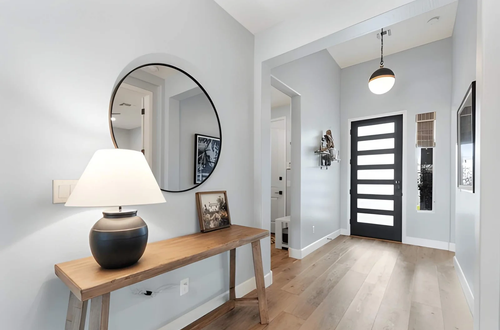
| Matte black | White, light grey, contemporary facades | Contemporary, sharp, deliberately modern |
| Burgundy/wine | Brick, stone, tan or cream facades | Rich, warm, historically grounded |
| Warm terracotta | Adobe, stucco, Mediterranean influences | Welcoming, specific, regionally authentic |
| Natural wood stain | Any facade — universally warm | Organic, artisan, handcrafted quality |
Beyond color, the door’s condition matters equally. A beautifully colored door with peeling finish, hardware that doesn’t function smoothly, or a screen door that obscures it undermines the focal point effect. The door needs to be the best-maintained element of the front entrance — because it’s the element that receives the most scrutiny.
The Approach: Designing the Path From Street to Door
The pathway from the street or driveway to the front entrance is one of the most underdesigned elements in US residential exteriors. Most pathways exist as the most direct route between two points, paved in whatever material was cheapest at construction, and left functionally unchanged for the home’s lifetime.
Captivating front entrances treat the pathway as the beginning of the design sequence — the element that establishes movement toward the door, frames the approach, and communicates quality before the door is even the primary focus.
Width matters. A pathway narrower than 36 to 48 inches feels like an afterthought — it requires single-file movement and communicates that guests weren’t really expected. A pathway at 48 to 60 inches allows two people to walk side by side and immediately feels more welcoming.
Material communicates. Concrete pavers, natural stone, brick, and decomposed granite all read differently as approach materials — each carries an aesthetic vocabulary that should relate to the home’s exterior architecture. Generic poured concrete that’s cracking or stained communicates neglect before anyone reaches the door.
Curves and destination. A pathway with a gentle curve rather than a straight shot creates a small degree of mystery — the door comes into full view only as the approach progresses, which creates an arrival experience rather than simply a shortest-path route.
Scale and Flanking: The Frame That Makes the Door
The elements that flank the front entrance — plants, light fixtures, architectural columns, or simply the proportion of the entry surround — determine whether the door reads as a focal element or simply an opening in a wall.
Flanking elements create a visual frame around the door that emphasizes it as a destination. They also provide scale reference — making the door appear appropriately sized in relation to the facade and the human body approaching it.
The most common flanking arrangement: a pair of plants (symmetrically placed, matching containers) at either side of the door, sized so their height reaches approximately one-third to one-half the door height. Plants that are too small disappear and fail to frame. Plants too large overwhelm and compete.
| Flanking Element | Scale Guideline | Character Effect |
|---|---|---|
| Matching container plants | 1/3 to 1/2 door height | Classic, welcoming, symmetrical |
| Architectural columns | Match facade’s architectural period | Formal, imposing, traditional |
| Paired sconces at face height | Eye level when standing at door | Intimate, considered, welcoming |
| Stone or raised planter walls | 18–24 inches — knee height | Structured, architectural, distinctive |
| Trained topiary or standard trees | 2/3 door height maximum | Elegant, deliberate, design-forward |
Lighting: The Front Entrance After Dark
Most US front entrances that look appealing during the day fail after dark — because exterior lighting was treated as a security function rather than a design element. A single overhead fixture above the door that creates harsh downward light and casts unflattering shadows is functionally adequate and aesthetically poor.
A captivating front entrance at night is lit from multiple sources at different heights: sconces at face height that illuminate the entry warmly from the sides, a path light system that makes the approach readable and welcoming, and potentially an uplighted tree or significant plant that creates landscape drama visible from the street.
The bulb temperature rule for exterior lighting is the same as for interior: 2700K to 3000K warm white throughout. Cool-white exterior lighting (4000K and above) is common in security contexts but reads as institutional rather than welcoming in residential front entrance applications.
The Finishing Details That Complete a Captivating Front Entrance
| Detail Element | What It Communicates | Common Mistake | Better Approach |
|---|---|---|---|
| Door hardware | Quality and care level | Brass hardware tarnished, mismatched | Consistent finish, polished or deliberately aged |
| House numbers | Legibility and style consistency | Small, hard to read, generic | Designed numbers at scale — 4-6 inches minimum |
| Doormat | Hospitality and threshold awareness | Worn, dirty, undersized | Fresh, correctly sized, style-consistent |
| Mailbox | Maintenance and detail care | Rusted, dented, out of scale | Replaced or refinished to match door hardware |
| Threshold and surround | Frame quality for the door | Paint peeling at surround edges | Best-maintained element of the whole entrance |
Frequently Asked Questions
What’s the single most impactful change to make a front entrance more captivating?
The front door color — specifically repainting it in a deliberate, considered color at sufficient contrast to the facade to read clearly from the street. This single change typically costs $30 to $80 in paint and a weekend of preparation and application. The visual return is consistently the highest of any single exterior improvement at comparable cost, and it establishes the focal point from which all other front entrance decisions can follow.
Do matching elements at the front entrance always look better?
Symmetry — matching plants, matching sconces, matching hardware finishes — reads as intentional and creates the formal framing quality that most captivating front entrances have. Asymmetry can work effectively when the home’s architecture is itself asymmetrical or when the asymmetry is deliberate and obvious. Accidental asymmetry (one plant significantly larger than the other, mismatched fixture sizes) reads as inattention rather than design.
How important is lighting to a captivating front entrance?
Essential — and increasingly so as the home is experienced more frequently in evening light. A front entrance that’s captivating during the day but dark or harshly lit at night is operating at half its potential impact. The shift from single overhead fixture to paired warm sconces at face height plus path lighting transforms the evening arrival experience for $150 to $400 in fixtures and is one of the highest-return front entrance investments available.
What plants work best for flanking a front entrance?
Evergreen plants that maintain their structure and appearance year-round — boxwood, Japanese holly, columnar yew, dwarf alberta spruce — are the most reliable flanking choices for US front entrances because they provide consistent framing regardless of season. Seasonal annual plantings in containers allow color variation through the year while maintaining the formal flanking structure that evergreens provide.
Should the front entrance match the rest of the exterior or contrast with it?
The most captivating front entrances use contrast deliberately — a door color that reads clearly against the facade, flanking elements that create visual separation from the surrounding walls, and lighting that distinguishes the entry from the rest of the elevation at night. Complete matching blends the entry into the facade and reduces its focal power. Complete contrast without relationship looks jarring. The ideal is a door and entry elements that are clearly distinct from the facade while sharing its material or color vocabulary.
The Bottom Line
A captivating front entrance doesn’t require architectural renovation or significant budget. It requires the specific design thinking that most homeowners have never applied to their entry sequence: a door with color deliberate enough to be the facade’s focal point, a pathway wide and well-maintained enough to frame the approach, flanking elements at the right scale to create a visual entry frame, and lighting that makes the entrance as welcoming at night as it is during the day.
These are decisions, not purchases. Most of the transformation available to any US front entrance is accessible within a few hundred dollars and a weekend of focused effort — applied in the sequence that builds from the focal point outward rather than decorating around an unresolved center.
Must visit decoratoradvice com for captivating front entrance ideas.

Jessica X
Writer at DecoratorAdvice com, sharing practical home design insights, décor trends, and expert tips to help readers create beautiful, functional living spaces.




One Comment
Pingback: