Terrace Decoration Decadgarden: How Do You Make a Narrow Terrace Feel Wider With Decoration?
A narrow terrace is one of those spaces that gets written off too quickly. It’s too small for a proper seating area, too exposed to ignore, and too visible from inside the home to leave bare. Most homeowners either overload it with furniture that doesn’t fit or leave it empty and underused — and both outcomes waste what could be one of the most enjoyable spaces in the home.
The truth is that narrow terraces respond exceptionally well to smart decoration. More than almost any other outdoor space, they’re transformed by specific, deliberate choices rather than large investments. The right furniture scale, the right visual tricks, the right planting strategy — applied correctly, these turn a tight corridor of outdoor space into something that reads as intentional, open, and genuinely livable.
That’s exactly what terrace decoration decadgarden addresses. This article covers the specific strategies that make narrow terraces feel wider — optical illusions that actually work, furniture choices that serve the space instead of filling it, vertical elements that draw the eye upward, and the decoration sequence that produces the best outcome. Whether your terrace is six feet wide or ten, the same principles apply.
Why Narrow Terraces Feel Smaller Than They Are — And How Decoration Fixes It
Before applying any fix, it helps to understand why narrow terraces read as cramped in the first place. The problem is almost always proportional — the length-to-width ratio creates a tunnel effect that makes the space feel like a corridor rather than a room. Decoration corrects this by redirecting where the eye travels and how the brain interprets the boundaries of the space.
Terrace decoration decadgarden consistently applies three optical principles to address this:
| Optical Principle | How It Works | Decoration Application |
|---|---|---|
| Horizontal line emphasis | Draws eye across the width, not down the length | Horizontal rail planters, wide rugs, low furniture |
| Vertical element use | Lifts eye upward, creates perceived height and openness | Tall plants, trellises, vertical wall features |
| Light reflection | Makes boundaries feel less defined | Mirrors, light-colored surfaces, metallic accents |
| Continuous flooring | Removes visual breaks that segment a narrow space | Single decking direction, consistent tile, one outdoor rug |
| Reduced furniture count | Prevents tunnel from feeling blocked | Fewer, appropriately scaled pieces with breathing room |
Terrace Decoration Decadgarden Strategies That Actually Widen a Narrow Space
Furniture Scale and Placement: The Foundational Decision
The most common narrow terrace mistake is choosing furniture that fits the length of the space without accounting for the width. A full four-seat dining set in a six-foot-wide terrace doesn’t leave enough room to pull a chair back comfortably — let alone walk past.
The rule for narrow terraces: every furniture piece should leave a minimum 30-inch clearance path along one side. That typically means going smaller than instinct suggests and supplementing with vertical elements rather than additional floor-level pieces.
| Terrace Width | Furniture Recommendation | What to Avoid |
|---|---|---|
| Under 6 feet | Bistro table (24″), folding chairs, wall-mounted seating | Any sofa or full dining set |
| 6–8 feet | Narrow loveseat, two chairs, small side table | Sectionals, large planters on floor |
| 8–10 feet | Small sofa, two chairs, coffee table | Oversized dining sets, bulky loungers |
| Over 10 feet | Standard outdoor seating group | Spreading furniture to fill all available space |
Go Vertical — It’s the Most Underused Strategy
In a narrow terrace, floor space is the constraint. Vertical space almost always isn’t. Terrace decoration decadgarden leans heavily on vertical elements for exactly this reason — they add visual richness and planting depth without consuming any of the limited floor area.
Practical vertical options for narrow US terraces:
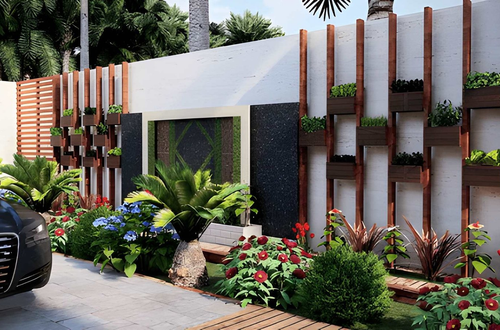
Wall-mounted planters in horizontal rows draw the eye across the width of the terrace rather than down its length — directly countering the tunnel effect.
Tall, slender plants like bamboo, ornamental grasses, or columnar junipers placed at the far end of the terrace create a destination point that makes the space feel longer in a positive way — like you’re walking toward something rather than being confined by walls.
Trellises with climbing plants serve double duty: they add privacy screening and introduce organic texture that softens hard terrace surfaces without taking floor space.
Flooring Direction Changes Everything
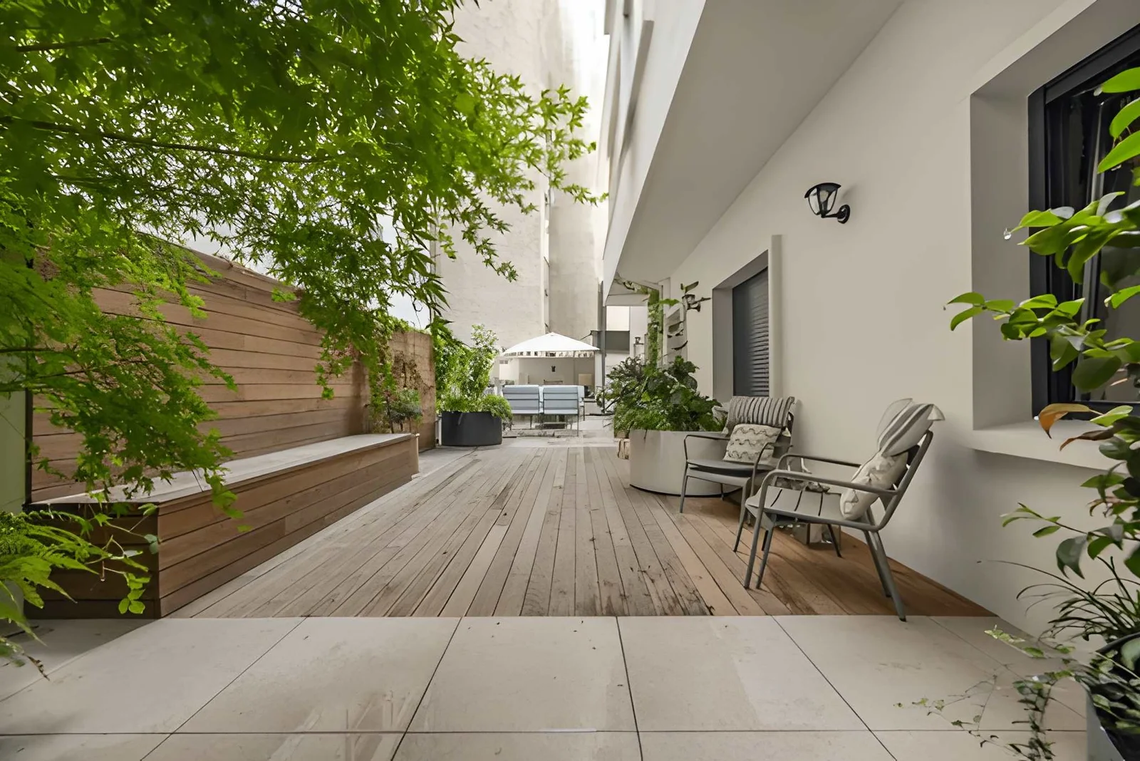
This is one of the most effective and least discussed strategies in narrow terrace decoration. Running decking boards, tiles, or an outdoor rug perpendicular to the length of the terrace — horizontally across the width — visually broadens the space in the same way that horizontal stripes broaden clothing.
If you’re working with existing flooring that runs lengthwise, a single outdoor rug laid crosswise achieves the same effect at minimal cost.
| Flooring Choice | Direction for Widening Effect | Additional Benefit |
|---|---|---|
| Composite decking | Boards run across width | Low maintenance, durable |
| Outdoor tile | Diagonal or horizontal pattern | Easy to clean, varied options |
| Outdoor rug | Laid across the narrow dimension | Instant, low-cost, removable |
| Gravel or pebble | No direction concern | Permeable, natural aesthetic |
Color and Material: Light Over Dark, Continuity Over Contrast
Dark flooring and dark furniture on a narrow terrace compress the space visually. Light-toned materials — pale timber, white or cream furniture, light grey tile — reflect more light and make boundaries feel less defined. This is particularly important for terraces that face north or receive limited direct sunlight.
Continuity matters equally. A narrow terrace with five different materials competing for attention feels more cramped than one with two or three materials used consistently. Reduce the material palette before adding decoration layers.
Plant Strategy for Narrow Terraces
Plants are where terrace decoration decadgarden delivers some of its most specific value. The wrong planting strategy makes a narrow terrace feel like a jungle corridor. The right one makes it feel like a curated garden room.
| Plant Type | Placement | Effect on Space |
|---|---|---|
| Tall columnar plants | Far end or corners | Creates destination, adds height |
| Wall-mounted horizontal planters | Along one or both walls | Draws eye across width |
| Low ground-level plants | Along one edge only | Defines without blocking |
| Climbing plants on trellis | Back wall or one side wall | Adds depth, reduces hard surfaces |
| Trailing plants in elevated pots | Railing or wall brackets | Adds softness at eye level |
The key principle: concentrate plants at the perimeter and vertical surfaces. Anything placed in the center of the floor reduces the already-limited walking space and makes the terrace harder to use.
Frequently Asked Questions
What is terrace decoration decadgarden and what does it cover?
Terrace decoration decadgarden is a focused outdoor decoration resource covering practical styling strategies for terraces, patios, and compact outdoor spaces. It’s particularly strong on narrow and awkward configurations that generic outdoor decor advice doesn’t address well.
What is the single most effective way to make a narrow terrace feel wider?
Running floor materials or an outdoor rug horizontally across the width rather than lengthwise down the terrace. It’s the fastest, often cheapest, and most visually impactful change you can make. After that, replacing dark furniture with lighter-toned pieces and adding vertical planting elements compounds the effect significantly.
How do I add privacy to a narrow terrace without making it feel smaller?
Use vertical greenery rather than solid screening. A trellis with climbing plants or a row of tall slender plants along one boundary adds privacy while maintaining airflow and light — both of which make a narrow space feel more open than solid fence panels or walls would.
Can I have a dining area on a very narrow terrace?
Yes, with the right furniture. A wall-mounted fold-down table takes up zero floor space when not in use. Bistro tables (typically 24 inches in diameter) with stackable chairs work for terraces as narrow as five feet. The key is choosing furniture that collapses or folds rather than pieces that occupy permanent floor space.
What outdoor lighting works best for a narrow terrace?
String lights hung along the length of the terrace at ceiling height add warmth without consuming floor space. Wall-mounted sconces or solar-powered stake lights along one edge define the perimeter without cluttering the center. Avoid large freestanding floor lamps — they eat into the limited walkable area and tip easily in wind.
The Bottom Line
A narrow terrace doesn’t have to feel like a compromise. Terrace decoration decadgarden approaches these spaces as a specific design challenge with specific solutions — not a scaled-down version of larger outdoor design advice.
Get the furniture scale right, run your flooring horizontally, go vertical with plants and screening, keep materials consistent and light-toned, and treat the walls as usable surfaces rather than just boundaries. Apply those principles in that order and the narrow terrace you’ve been ignoring becomes one of the more enjoyable spaces your home has to offer.
Must visit https://decoratoradvice.fr/ for terrace decoration.

Jessica X
Writer at DecoratorAdvice com, sharing practical home design insights, décor trends, and expert tips to help readers create beautiful, functional living spaces.


You May Also Like
Practical decadgarden yard tips by decoratoradvice for a Fall Yard That Looks Good Into November
7 Backyard Renovation Decoradyard Ideas That Add Real Value to Any Home