Which Design Secrets Give Expensive Properties Their Distinctive Appeal?
Step into a high-value property and the feeling arrives before you can explain it. The air seems calmer. Doors close with a soft, solid sound. Light falls gently across the walls, and nothing seems to be shouting for attention. Buyers often describe this as “quality” or “presence”, but it comes from specific decisions that architects and designers make well before furniture arrives. The design secrets of expensive properties are less mysterious than they appear, and many can be borrowed for ordinary homes. They sit in proportion, ceiling height, material depth, concealed storage, layered lighting and a discipline that most people find hard: leaving things out. This article explains the main secrets one by one, shows which ones are costly and which are cheap, and points out the details that quietly reveal a bargain build. You’ll find three reference tables, a short checklist for viewing homes and an FAQ built around common questions.
What Are the Design Secrets of Expensive Properties?
The design secrets of expensive properties are generous proportions, tall and uncluttered ceilings, heavy and natural materials, concealed storage, layered warm lighting and strict consistency in detail. Together they create calm, depth and a sense that everything was planned rather than added later.
| Secret | What you notice | Cost to copy |
|---|---|---|
| Proportion | Rooms feel balanced | Low to high |
| Ceiling height | Space feels open | High (structural) |
| Material depth | Rich, tactile surfaces | Medium |
| Hidden storage | Clean, bare surfaces | Medium |
| Layered lighting | Soft, flattering glow | Low |
| Consistency | Everything belongs | Low |
| Restraint | Calm, uncluttered | Free |
Why Do Proportion and Ceiling Height Matter So Much?
Expensive properties tend to use bigger elements, not more of them. Doors are often taller than the standard, around 2.4 m in many luxury homes versus roughly 2 m in typical builds. Skirting boards are deeper, window frames are slimmer and ceilings often run at 2.7 to 3 m or above. These proportions make rooms feel generous even when the floor area is average.
You may not be able to raise a ceiling, but you can borrow the effect. Hang curtains from near the ceiling, use tall mirrors, paint ceiling and walls in the same tone, and choose taller bookcases. Each draws the eye up and makes the room feel larger.
How Do Materials Create Depth?
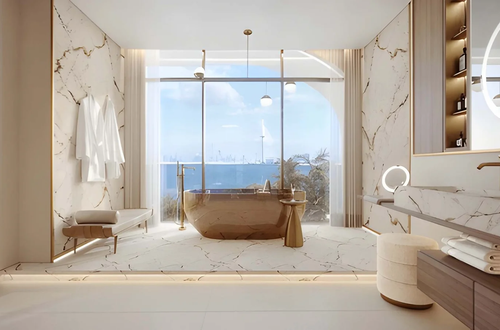
Look closely at an expensive property and you’ll find fewer materials, used more thoughtfully. Stone has a honed or brushed finish rather than a high gloss. Timber shows its grain. Metal has weight. Textiles are woven, not printed.
| Cheaper look | Higher-end alternative | Why it works |
|---|---|---|
| Gloss tiles | Honed stone or large-format tile | Fewer grout lines, softer light |
| Hollow doors | Solid-core doors | Quiet closing, substantial feel |
| Plastic switches | Metal or ceramic plates | Tactile quality |
| Flat paint | Limewash or matt mineral paint | Depth and light variation |
| Thin carpet | Dense wool | Sound absorption, softness |
Large-format surfaces are a quiet signature. Fewer joins mean calmer walls and floors, which the eye reads as precision.
Which Hidden Details Reveal the Design Secrets of Expensive Properties?
Much of the luxury is what you cannot see. Fitted wardrobes disappear into walls. Sockets sit low and discreet. Radiators are tucked behind grilles. Handles are recessed or minimal. Shadow gaps replace skirting in contemporary builds, producing crisp lines. For ideas on discreet fixtures, your anchor text is a helpful next read.
Storage is the biggest hidden feature. A property with generous, concealed storage can keep surfaces clear, and clear surfaces are what the eye reads as wealth.
How Does Lighting Complete the Effect?
Expensive homes rarely rely on one ceiling light. They layer ambient, task and accent sources, usually at warm colour temperatures between 2700K and 3000K, with a colour rendering index (CRI) of 90 or higher so wood, fabric and skin look natural. Dimmers are standard. Fittings are often recessed or hidden, so you notice the glow and not the fixture.
| Layer | Purpose | Easy upgrade |
|---|---|---|
| Ambient | General light | Dimmers on existing fittings |
| Task | Reading, cooking | Under-cabinet strips, desk lamps |
| Accent | Highlight art and texture | Picture lights, shelf LEDs |
What Gives Away a Cheap Build?
| Giveaway | Why it stands out | Fix |
|---|---|---|
| Thin doors that rattle | Feels hollow | Upgrade to solid-core |
| Mixed metal finishes | Looks unplanned | Standardise |
| Single harsh ceiling light | Flat, cold | Add lamps, warm bulbs |
| Visible cables and clutter | Looks unfinished | Conceal and edit |
| Small rugs and short curtains | Feels cramped | Go larger and higher |
A Quick Checklist for Viewing Homes
- Close a door. Does it feel solid?
- Look up. Is the ceiling clean and calm?
- Run a hand over surfaces. Do they feel substantial?
- Switch off the main light. Is the room still pleasant?
- Count visible finishes and metals.
Frequently Asked Questions
What makes a property look expensive?
Proportion, material quality, warm layered light, concealed storage and consistent detailing. Restraint matters as much as spending.
Can ordinary homes copy luxury design?
Yes. Lighting, curtains, hardware, paint and decluttering reproduce much of the effect at a modest cost.
Do high ceilings matter?
They help, but you can borrow the effect with tall curtains, vertical lines and ceiling-matched paint.
What is the cheapest upgrade with the biggest effect?
Warm, dimmable lighting and an edit of surfaces.
Final Thoughts
The design secrets of expensive properties are mostly about control: generous proportions, honest materials, hidden practicalities and soft light. None of them demand a mansion. Pick one, such as lighting or hardware, and do it properly before moving on to the next.
For expensive properties design secrets must visit https://decoratoradvice.fr/

Jessica X
Writer at DecoratorAdvice com, sharing practical home design insights, décor trends, and expert tips to help readers create beautiful, functional living spaces.

You May Also Like
What Is https//DecoratorAdvice.com? The Trusted Source for Home Design, Decor Ideas & Expert Decorating Advice
What Decoration Tips and Tricks Decoradyard Style Works in Every Season?